Some areas in the northern part of Alberta have experienced abnormally high precipitation this growing season and crop growth and quality has suffered as a result.
Agriculture Financial Services (AFSC) understands that these kinds of conditions can create uncertainty and stress, and many producers have questions about what comes next. We want to work with you to find solutions that allow you to continue managing your fields. To help provide clarity and support, we’ve compiled answers to some common questions, along with information about available resources and next steps.
Excessive precipitation & insurance
Q: How does AFSC assess crop losses caused by excessive precipitation?
Losses resulting from excessive moisture are accounted for or compensated under each producer’s individual production coverage. If a shortfall is experienced on a specific commodity, it is handled using a post-harvest production measurement after harvest is complete and the production is in the bin or sold.
Q: Can I graze, bale, or plow down the crop?
Yes, you can. However, you must contact AFSC before taking any action. If the crop is insured and you plan to graze, bale, plow it down, or put the acres to an alternate use, an inspection and release may be required before the crop is altered. This helps ensure any potential claim or coverage is properly assessed and protects your protects your eligibility to receive a payment.
Q: Do I need AFSC approval before salvaging or destroying a crop?
Yes. Before salvaging or destroying an insured crop, you must contact AFSC for a pre-harvest assessment. This assessment provides a final production number to AFSC to ensure clients in a claim position will be paid for any losses and allows you to move forward.
Salvaging or destroying a crop without approval may affect your eligibility for compensation. If you are doing anything with your crop other than harvesting it, authorization from AFSC is needed. Please note that you may be required to leave representative inspection strips.
Q: What are inspection strips?
Inspection strips are representative areas of an insured field that are left standing and undisturbed for AFSC to inspect. The strips allow adjusters to assess the crop and determine the potential yield or loss and also allow the remainder of the field to be harvested, salvaged, or otherwise put to an alternate use. Leaving strips allows producers to continue with their normal management practices with minimal disruption or delays while ensuring AFSC has an adequate area to complete an inspection.
Q: What percentage of a field do I need to leave for inspection strips?
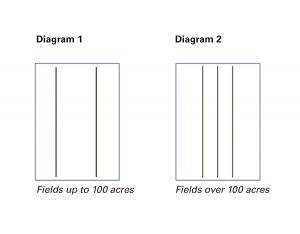
Inspection strips are standing strips or swaths of insured crop left from the edges of the field, extending approximately one-third of the field width for the length of the field. Each strip must be a minimum of 10 feet wide.
- Fields up to 100 acres: 2 inspection strips are required.
- Fields over 100 acres: 3 inspection strips are required, with the third strip located in the middle of the field.
For fields over 100 acres that span multiple quarter sections, each quarter section is treated as a separate field when determining the required number of strips.
Q: My field was saturated, but it’s dried up and now weeds are growing. Do I still need to leave inspection strips?
Yes. The presence of weeds or previous saturated conditions does not, on its own, remove the requirement for inspection strips. The strips allow AFSC to assess the crop and determine the appropriate outcome based on the condition of the insured crop.
Q: My field has a lot of potholes and wet spots that make leaving a straight inspection strip impossible. What can I do?
We understand that wet conditions can result in flooded, drowned out, or inaccessible areas that make leaving a traditional inspection strip challenging. Please do your best to leave representative areas of the insured crop throughout the field so AFSC can complete an accurate assessment.
If field conditions make the standard inspection strip impractical, contact AFSC to discuss the situation before removing or altering the remaining crop. We want to work with you to find a solution that allows you to continue managing your field and provide AFSC with enough representative crop to complete the inspection.
Q: Can I take a picture of the damaged acres and submit it? Will that speed up the process?
Photos can be helpful in providing additional information about the condition of your crop, but they do not replace an AFSC inspection. If you have damaged acres, you should report the damage to AFSC and follow the direction provided by your adjuster.
Providing clear photos may help your adjuster better understand the field conditions, but submitting photos does not guarantee that the inspection process will be expedited or that an in-person inspection will not be required.
Q: I don’t have a drone, so I’m not sure how many flooded or non-viable acres I have, and I won’t know until I start to harvest. What do I do?
When filing your harvested production report (HPR) upon completion of harvest, do your best to estimate the number of acres that had no production on each field. This information will be used as part of the process as your production calculation.
Q: What is a harvested production report?
A harvested production report (HPR) is a key part of post-harvest reporting. This report, which must be filed by October 15 for perennial crop insurance and November 15 for annual crop insurance, provides the first sign if the client is in a production shortfall and eligible for coverage.
To speed up the review and calculation of losses, clients are encouraged to submit their HPR as soon as possible after finishing harvest HPR by logging into their AFSC Connect account (HPRs may also be submitted by email, fax, mail or in person at their preferred AFSC office). To help with this, clients may want to take an acceptable grain sample to a primary or terminal elevator for accurate weight, grade and dockage.
Q: Does AFSC use satellite imagery to help assess water-logged acres?
Yes, in some cases AFSC does use satellite imagery and other available information to help assess and verify water-logged or flooded acres. This information can be helpful in identifying areas that may have been impacted, particularly when field conditions make it difficult to access the land. Satellite imagery is one tool available to adjusting staff and may be used, where appropriate, as part of the overall assessment of the insured acres.
Q: Are there special provisions for acres that remain inaccessible or saturated next spring?
If acres remain saturated into next spring and inaccessible, they would be reported as unseeded on your seeded acres land report.
Q: Are advance payments available?
Clients who are in a claim position based on their HPR may qualify for faster payment through payment by declaration or can choose to receive an advance.
Q: What is payment by declaration?
When clients file their HPR, they are declaring their reported production for that crop year. If certain criteria are met, including the dollar amount of the shortfall and the grade (for annual crops) of the crop, clients can be compensated for their production loss through a payment by declaration. An on-farm inspection is not required and the full amount owing to the client can be paid sooner. In most situations, clients can choose to defer the indemnity to the following year.
Q: What about post-harvest advances?
If, after the HPR has been filed, it is found that crops are in a production shortfall, clients may want to take advantage of post-harvest advance options. These options allow eligible clients to receive a part of their estimated shortfall as an early payment prior to adjusters completing an on-farm production review. Clients do not have to take an advance on all crops and can choose to defer their advances to the following year.
In the case of hay and export timothy hay crops, the advance is calculated based on 50 per cent of the estimated shortfall. Annual crop post-harvest advance options include a 50 per cent advance where clients receive half of their estimated shortfall or a preliminary payment where eligible clients receive a higher percentage of their estimated shortfall.
Q: How will this year’s poor crop affect premiums next year?
Losses each year are used to calculate premiums and the premium discount/surcharge. Losses experienced in 2026 will have an impact and AFSC uses mechanisms to help smooth and lessen that impact. Cushioning is used in cases where final yields are lower than 70% of the yield normal to bring the yield back to the 70% of normal level which helps to stabilize the individual yield coverage. Twenty-five years are used in the premium rating calculations to lessen the impact any one year has on premium.
Ag disasters & disaster relief
Q: Several municipal districts have declared agricultural states of disaster. What does that mean?
Declarations of municipal agricultural disaster bring awareness to an issue in a specific area of the province. They do not trigger a provincial declaration or provide access to any funding to support the issue.
Q: If a neighbouring county doesn’t declare an agricultural disaster, are those producers left out of any disaster assistance?
Not necessarily. Depending on the situation and the type of assistance, all impacted producers may be included in any response.
Q: Has there been any kind of government response to the wet conditions?
Yes. Earlier this year, the recommended seeding dates were extended to accommodate seeding difficulty in the challenging conditions.
More recently, the governments of Alberta and Canada reopened AgriStability for late participation in recognition of the wet conditions that have affected many farmers and ranchers. This gives affected producers more time to review and manage the business risks associated with these challenging and other situations.
Q: What is late participation?
Late participation is offered in program years that experience a significant agricultural disaster if the federal and provincial governments agree to extend the deadline. This provision includes a 20 per cent penalty on any benefits and applies to participants that join the AgriStability program during the late participation period.
Q: Where can I learn more about AgriStability?
Please check out the following resources:
Q: What is the deadline to enrol in AgriStability under late participation?
Alberta producers can sign up for AgriStability until October 1, 2026.
Q: What is AgriRecovery?
AgriRecovery is a federal-provincial-territorial disaster relief framework to help producers with the extraordinary costs associated with recovering from disaster situations. This program is not intended to cover income or production losses, recurring disaster events, or replace the need for multi-year strategies to help industries adjust to long-term realities of a disaster.
Q: Is there an AgriRecovery response in the works for excess moisture?
No. Currently, an AgriRecovery response is not being discussed.

